Tomorrow’s energy demand is not a single number waiting to be discovered. For a commercial site, consumption can move with production schedules, occupancy, weather, equipment cycles, charging loads, and unexpected operating changes. AI-driven commercial energy management systems try to turn those repeating patterns into a forecast that is useful for scheduling rather than merely descriptive.
The value of prediction lies in estimating what the site is likely to need early enough for storage, generation, and grid purchases to be prepared for that demand.
Prediction Starts With a Structured Operating History
Any useful forecast begins with a time sequence of what the site has already done. A digital control platform can organize historical consumption by hour, day, weekday, season, operating shift, or production state, then look for recurring relationships instead of treating every reading as an isolated event.
A factory that starts several large loads at the same time each morning creates a different signature from an office building whose demand follows occupancy and cooling requirements. Forecasting becomes more reliable when the system can distinguish those patterns and preserve the differences between them instead of collapsing them into one average.
AI does not remove the need for context. Commercial energy management systems generally perform better when historical load data can be interpreted alongside known operating conditions such as planned production, calendar effects, weather-sensitive demand, or equipment schedules.
A prediction can then be expressed as an expected load curve with timing and magnitude, which is more useful than a vague statement that consumption will be “high” or “low.” The result is useful because timing matters: storage has to know not only how much energy may be required, but when the likely rise in demand will occur.
Real-Time Data Keeps the Forecast Connected to Reality
For commercial energy management systems, a day-ahead estimate becomes less valuable if the site changes materially after the forecast was produced. The forecasting layer therefore needs current operating data so that new information can be compared with the expected pattern. Cell voltage, temperature, facility consumption, generation, and asset status can all affect how much flexibility is actually available.
If demand develops differently from the earlier estimate, dispatch logic can be revised so the system does not continue following an outdated schedule.
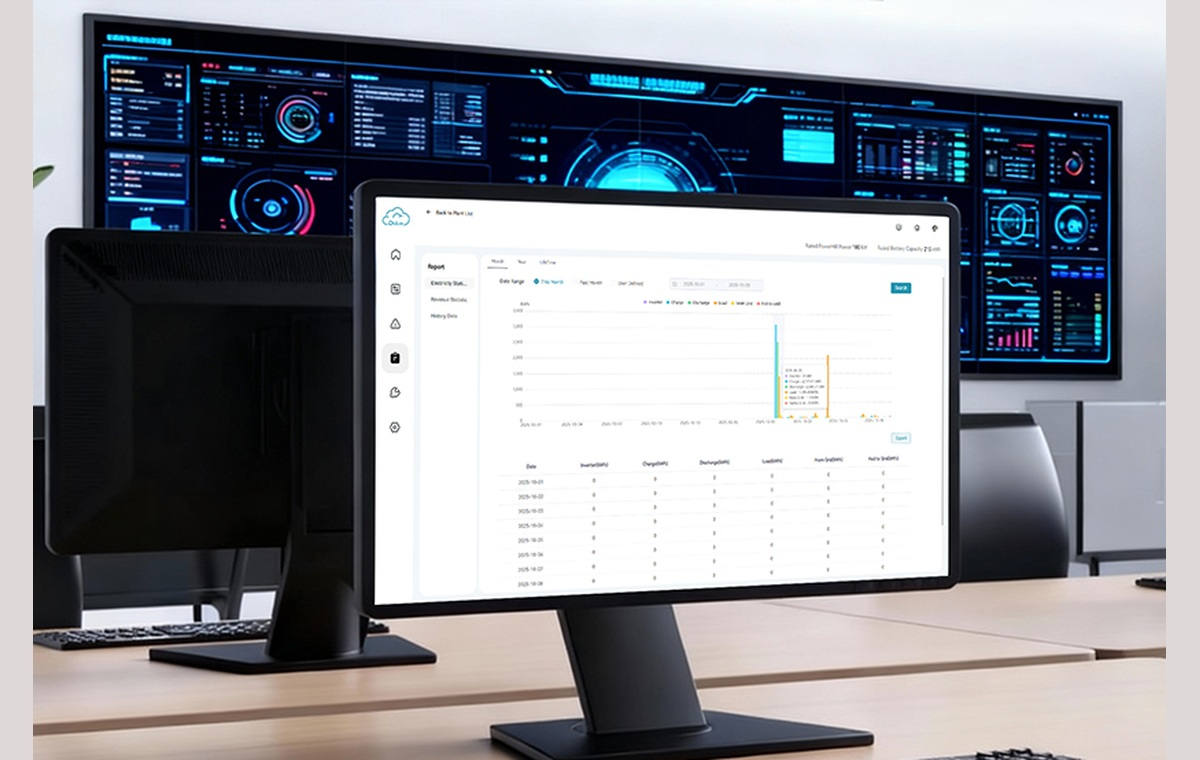
Within Dunext’s DuLink platform, the monitoring layer records cell-level voltage and temperature in real time, presents generation, revenue, and electricity-consumption information through panoramic dashboards, and includes an interactive energy-flow view. DuLink’s AI optimization function analyzes energy-use patterns and provides strategy recommendations.
Dunext does not specify a dedicated day-ahead forecasting module for DuLink, so the documented capability is data-driven analysis and operational optimization rather than a claimed next-day prediction function.
Forecasting Matters Because Storage Has Limited Time and Energy
Prediction becomes operationally useful when it changes what the site does before demand arrives. Commercial energy management systems can use an expected load curve to determine whether a battery should preserve charge, begin charging earlier, or avoid spending stored energy on a low-value period.
A forecast of a late-afternoon peak, for example, can influence the state of charge maintained during the preceding hours. The same logic can help keep flexibility available for an expected production increase or a period of high grid consumption.
The dispatch plan also has to respect physical limits. A battery may have enough energy for one peak period but not for several long peaks, and charging power can limit how quickly reserve capacity is restored. Forecasting therefore works best when it is connected to asset condition and operating constraints rather than treated as a separate analytics feature.
The question is not simply whether tomorrow’s load can be estimated, but whether the available equipment can be scheduled intelligently around that estimate.
Multiple Sites Change the Scale of the Problem
Forecasting and optimization become more complex when an operator manages several distributed systems. Commercial energy management systems need a way to compare assets, identify unusual behavior, and separate a local anomaly from a portfolio-wide trend. DuLink provides a unified asset view with aggregated statistics and filtering for operators responsible for more than one system.
Its one-click service function can also submit faults, gather relevant logs and data automatically, and route them to technical support.
Those service functions matter because a forecast is only useful when the assets expected to respond are actually available. The analytics layer may identify a favorable dispatch window, but a faulted or constrained battery can change the feasible plan. Bringing monitoring, fault handling, analytics, and asset control into one environment reduces the gap between prediction and execution.
In practice, tomorrow’s energy plan is strongest when the forecast, the current equipment state, and the operating response are continuously reconciled.
Day-ahead energy planning becomes useful only when forecasting, live operating data, and asset limits remain linked as conditions change. Historical patterns provide the first estimate, live data tests whether those patterns still apply, and operating constraints determine what response is realistic.
Dunext’s documented DuLink functions support monitoring, analytics, AI-based strategy recommendations, fault handling, and multi-asset oversight, while the supplied information stops short of claiming a specific day-ahead forecasting engine.
The practical objective of commercial energy management systems is not perfect foresight, but enough advance visibility to place energy and equipment capacity where tomorrow’s operating conditions are most likely to need them.