Quality in a one-stop manufacturing program is not created by final inspection alone. It is accumulated through design decisions, supplier controls, process definition, test coverage, change management, and the way mechanical and electronic work are coordinated.
A provider that can handle PCB design and assembly, enclosures, and packaging under one project structure may reduce handoffs, but integration only becomes valuable when each stage has clear acceptance criteria and traceability. A practical checklist follows the chain from design-for-manufacturing through material sourcing and trial builds to final box-build verification; the label ‘one-stop’ by itself does not establish quality.
Check Whether Quality Starts Before Production
Quality starts before a production line is active. Bringing DFM into the engineering stage is one function of one-stop custom fabrication services, giving China electronics manufacturers an opportunity to examine PCB layout, enclosure structure, component selection, tooling, assembly access, and testability before recurring defects are built into the process.
A design that is difficult to assemble consistently creates a quality problem before the first production unit exists. Reviews that address yield, assembly time, and cost can prevent defects earlier and reduce dependence on final inspection. Prototype and trial-build discipline belongs on the same checklist.
Early samples test function and fit, while small production runs reveal variation in fixtures, operator steps, soldering, molding, fastening, programming, and inspection. Prototype availability by itself is weak evidence; the stronger sign is that findings from prototypes and NPI are converted into controlled design or process changes before volume release.
Testability deserves explicit attention because a product that cannot be measured efficiently may create hidden cost or weak defect detection at scale. Programming access, electrical test points, mechanical inspection features, and clear pass-fail limits are part of fabrication quality even though they are defined before routine production begins. Tooling review is similar: mold or fixture design affects repeatability, not merely appearance or cycle time.
Verify Process Controls, Testing, and Management Systems
Inspection points only become useful when they cover the complete material-to-finished-goods path. In one-stop custom fabrication services, that continuity exposes a practical difference among China electronics manufacturers: some controls remain departmental, while others stay connected across incoming material, assembly, validation, and shipment.
Minewing operates under an ISO 9001-certified quality-management system and lists inspections, testing, and validation before shipment. Its certifications include ISO 9001:2015 quality management and ISO 14001:2015 environmental management. Certification does not eliminate the need to examine the actual project flow.
The checklist can ask how nonconforming material is identified, how test results are recorded, how firmware versions are controlled, how approved changes reach production, and which characteristics are checked at PCBA, enclosure, assembly, and final-product stages. The objective is to see whether quality information moves with the product instead of being recreated independently at each department.
Look for Control Across PCBA, Enclosures, and Supply Chain
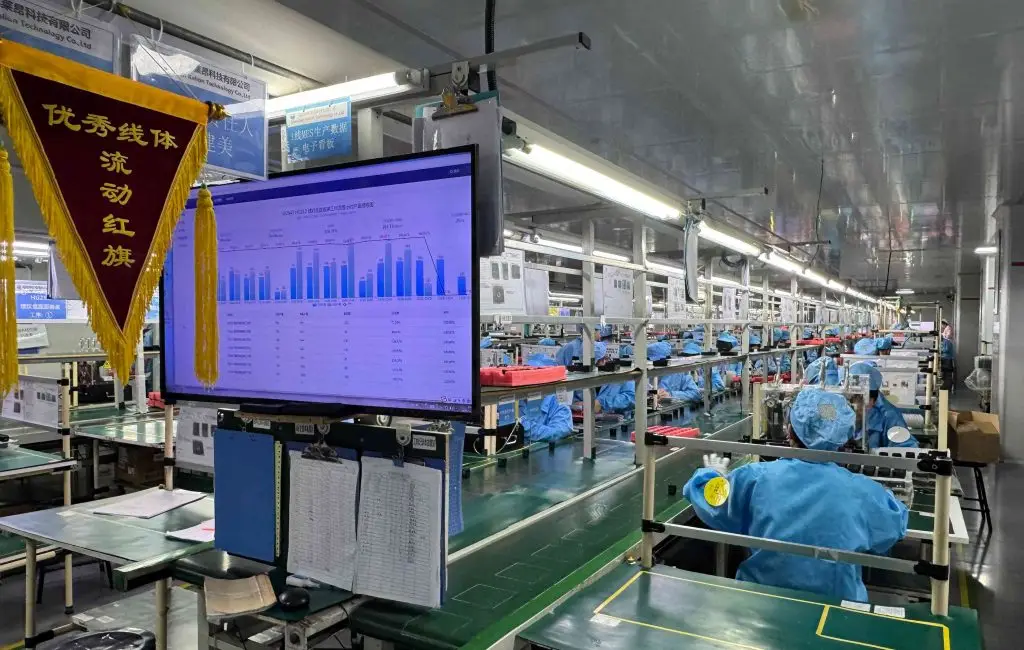
Electronic and mechanical quality controls become interdependent once a product moves beyond PCBA. That synchronization is where one-stop custom fabrication services become most useful, and China electronics manufacturers can then be assessed by how component sourcing, PCBA, enclosure production, final assembly, testing, packaging, and delivery operate as one controlled sequence.
In Minewing’s one-stop flow, PCBA and enclosure optimization feed the same full-product integration path, keeping assembly, testing, and packaging connected to the approved design. Supply-chain validation is a quality issue as well as a purchasing issue. Minewing’s NPI work includes sourcing and validating key components and vendors, while DFM is used to improve production yield and reduce assembly time and cost.
A substitute component, resin, connector, sensor, or battery can change product behavior even when it appears commercially equivalent. The checklist needs approval rules for substitutions and a way to trace which approved source entered each production build.
Confirm That Quality Can Scale with the Order
Volume changes the evidence a quality system has to control. A final test for one-stop custom fabrication services is whether controls remain workable as volume changes, because China electronics manufacturers may be capable of building a prototype but not of preserving the same process at scale. Because Minewing imposes no strict MOQ, its quality controls have to remain workable across a single prototype, low-volume trial runs, and full-scale mass production.
Its operations include China capabilities focused on R&D, engineering, and precision assembly and a Vietnam facility positioned for scalable mass production and added supply-chain flexibility. Scale changes the nature of quality risk. Higher output increases the importance of fixture repeatability, supplier capacity, work instructions, material planning, process monitoring, and failure feedback.
A complete checklist asks whether the first units pass inspection and, more importantly, how the manufacturing system responds when volume, location, or supplier load increases. Consistency across that transition is a stronger indicator of manufacturing quality than a single polished sample. A useful quality checklist follows the product through its entire manufacturing system.
DFM reveals whether the design is inherently buildable; prototypes and NPI expose variation before ramp; management systems and test records show whether results are controlled; sourcing rules protect the approved design; and box-build integration keeps electronics, enclosures, assembly, and packaging aligned.
Minewing’s model combines these stages with ISO-certified management, no strict MOQ, and production capabilities in China and Vietnam. Quality depends on keeping design decisions, materials, process controls, inspections, and change records connected from the first prototype to repeated production.
A mature quality system also preserves traceability when a defect is found, making it possible to connect the failed unit with its material source, process history, test result, and approved product revision. That feedback turns inspection data into corrective action instead of leaving it as an isolated pass-fail record.