Warehouse automation is not simply about moving products faster. Manufacturers, distributors, and third-party logistics providers need reliable material flows between receiving, storage, picking, packing, and dispatch. Automated guided vehicles (AGVs) can reduce repetitive transport work, but the right configuration depends on route stability, load requirements, traffic, and integration with existing systems. Choosing an approach that fits these operating conditions helps businesses plan investment around measurable needs.
- Compare Route-Based AGVs and Autonomous Mobile Robots
Traditional AGVs often operate along predefined routes or guidance paths, making them suitable for repeatable transport between fixed stations. Autonomous mobile robots (AMRs) generally use onboard sensing and navigation to move through mapped spaces and respond to obstacles. Actual navigation capabilities vary by vehicle and configuration.
For stable material flows, a route-based vehicle can be sufficient. Warehouses with frequently changing workstations or variable routes might benefit from more flexible navigation. Compare route modification, traffic coordination, obstacle handling, and software requirements before deciding which architecture suits the facility.
- Start With the Material Flow
Before comparing AGV solutions, map how materials move throughout the site. Identify repeated transfers, average trips per hour, payloads, travel distances, pickup points, and delivery deadlines. Include peak-period demand rather than relying only on daily averages.
This analysis reveals whether mobile robots should serve production lines, replenish picking stations, transport finished goods, or connect warehouse zones. It also helps identify bottlenecks caused by waiting for lifts, blocked aisles, manual handoffs, or poorly positioned staging areas. Automation should address a defined operational constraint instead of adding vehicles without a clear purpose.
- Match Payload and Chassis Design
Vehicle capacity affects drive selection, battery demand, chassis structure, and stopping behavior. Calculate the complete transported mass, including containers, fixtures, lifting equipment, and any payload carrier. Consider weight distribution and turning loads as well as the nominal payload.
Compact designs benefit from components that combine functions without compromising service access. Kinco’s mobile-robot solution includes integrated drive modules designed to support compact chassis layouts. The final vehicle payload depends on the selected drive configuration, wheel arrangement, chassis structure, and overall mechanical design. The available payload and performance depend on the complete vehicle configuration, so engineering teams should verify component ratings against actual operating conditions.
- Select the Appropriate Motion Hardware
Drive components influence acceleration, traction, turning, positioning, and maintenance. Separate motors, gearboxes, drives, and wheels provide flexibility, but require additional mounting, wiring, and compatibility checks. Integrated modules combine selected functions to simplify mechanical and electrical integration.
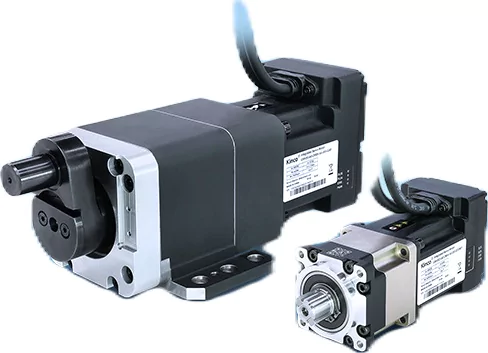
The iWMC integrated servo wheel module packages the drive, motor, gearbox, and wheel in one assembly. The iGMK integrated servo reducer motor offers another option for AGV and AMR power systems. For equipment builders, evaluating motion control for industrial robotics starts with payload, travel speed, wheel layout, torque, and the chosen control architecture.
- Assess Navigation and Fleet Coordination
Navigation determines how vehicles follow paths, recognize obstacles, and reach destinations. Fleet coordination manages vehicle assignments, traffic conflicts, priorities, and charging schedules. These functions should work together, particularly when several vehicles share narrow aisles or service multiple production areas.
Check how the proposed system exchanges status and task information with warehouse management systems, manufacturing execution systems, programmable logic controllers, and other equipment. Define what happens when communication is interrupted or a destination becomes unavailable. Clear recovery procedures help operators manage exceptions without disrupting the entire material flow.
- Account for Safety and Charging
Mobile robots often share floor space with employees, forklifts, and stationary machinery. Review pedestrian crossings, speed limits, emergency stops, protective sensors, load stability, and maintenance access during site planning. The finished vehicle and deployment require an appropriate safety assessment, not just a review of individual components.
Battery autonomy and charging arrangements also affect availability. Opportunity charging can suit fleets with predictable pauses, while scheduled charging can fit operations with defined idle periods. Compare actual energy demand, charging time, peak transport requirements, and fallback procedures before establishing fleet size.
- Evaluate Integration and Maintainability
Procurement cost is only one element of an automation project. Installation labor, control integration, route configuration, training, spare parts, and service downtime also influence total cost. Integrated and modular component architectures can reduce assembly complexity, but the actual benefit depends on vehicle design and maintenance practices.
Kinco’s published mobile-robot solution emphasizes integrated components, modular powertrain design, and cascaded communication for simpler connections and commissioning. When assessing a supplier, verify model compatibility, communication interfaces, dimensional drawings, diagnostic tools, and replacement procedures. Technical support and documentation should be available for the specific equipment being purchased.
- Validate the Design Before Scaling
A controlled pilot provides evidence about how a vehicle performs in the actual warehouse. Test representative payloads, busy traffic periods, repeated stops, charging cycles, and delivery handoffs. Record completed missions, waiting time, manual interventions, downtime, and missed delivery targets.
Use the results to identify whether limitations come from vehicle capacity, route planning, charging, workstation design, or software integration. Once the workflow meets operational targets, expand in stages and review performance as traffic and inventory patterns change.
Choose a Solution That Fits the Operation
Effective warehouse automation combines suitable vehicles, correctly sized drive components, coordinated software, and practical operating procedures. Businesses should compare AGV solutions against their material flows and technical requirements rather than selecting equipment solely by price or advertised performance.
Kinco Automation provides motion-control products and integrated mobile-robot components for AGV and AMR applications. Reviewing the relevant product specifications, communication interfaces, installation requirements, and support arrangements helps manufacturers and system integrators determine whether the proposed architecture fits their warehouse and future expansion plans.