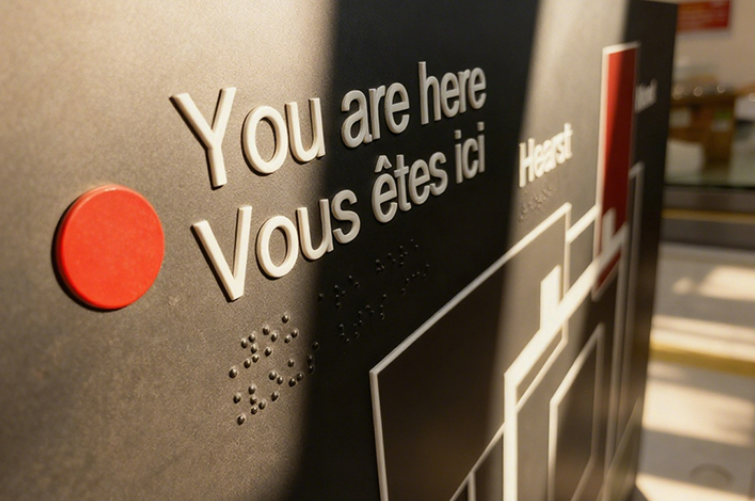
Building managers, architects, contractors, and signage distributors must balance accessibility requirements with interior design and long-term maintenance. 3D-printed ADA signs offer a practical approach by combining raised lettering, tactile graphics, Braille, and customizable visual elements. COSUN SIGN manufactures these signs using direct UV/LED 3D-printing technology, supporting projects that require consistent room identification, accessible wayfinding, and coordinated interior signage across commercial and public facilities.
How 3D Printing Supports Tactile Information
The primary purpose of accessible signage is to communicate information through touch as well as sight. 3D printed ADA signs can incorporate raised characters, symbols, and tactile details directly onto compatible sign substrates. This construction allows room names, numbers, and functional identifiers to remain part of the overall sign design.
Direct UV/LED printing provides flexibility in producing raised elements and detailed graphics. According to COSUN SIGN, its process supports raised characters and fully domed Braille, with printed elements bonded directly to the substrate. This approach can reduce reliance on separately applied components while supporting consistent visual and tactile presentation.
For facility operators, the production method is only one part of the decision. The finished sign must remain legible, appropriately positioned, and suitable for the location where it will be installed. Buyers should evaluate tactile clarity, surface quality, and material compatibility before approving a complete signage package.
Balancing Custom Design With Accessibility Requirements
Commercial properties often use signage to reinforce an established visual identity. Hotels may coordinate room identifiers with their interior finishes, while offices and healthcare facilities may require consistent symbols, colors, and naming conventions across multiple departments. Customization helps these projects maintain a recognizable design without overlooking accessibility.
When specifying ADA braille signs, procurement teams should distinguish decorative preferences from mandatory accessibility features. Sign dimensions, character styles, tactile lettering, Braille placement, and contrast need to be reviewed against the requirements applicable to the project. Decorative backgrounds and brand graphics should not interfere with the information users need to identify by sight or touch.
COSUN SIGN offers customization options that include sign sizes, fonts, colors, pictograms, logos, and background artwork. Compatible substrates include acrylic, painted inserts, and metal laminates. These options allow project teams to coordinate signs with different interior finishes, provided the final specifications preserve the required accessibility characteristics.
For projects in the United States, buyers should verify applicable ADA requirements and relevant building codes before production. A custom appearance does not automatically establish compliance, so approved drawings and specification checks should form part of the purchasing process.
Choosing Materials for Different Building Environments
Material selection influences a sign’s appearance, installation method, and ability to withstand routine use. Acrylic can support clean, contemporary interior designs, while painted inserts and metal laminates may suit projects with different surface finishes. The choice should reflect the installation environment, cleaning practices, mounting requirements, and expected frequency of use.
For offices, hotels, schools, and healthcare facilities, buyers should assess whether the selected substrate is compatible with the intended location. Surface adhesion is also important because raised characters and tactile dots must remain securely attached during normal service. COSUN SIGN describes testing its printed signage for adhesion strength and long-term performance.
Durability should be assessed alongside accessibility rather than treated as a separate consideration. Scratched surfaces, damaged tactile elements, or deteriorating graphics can affect the usefulness of a sign. Procurement teams should therefore request relevant product specifications and samples where appropriate, particularly when a project involves several material types or a large number of signs.
Planning Signage for Multi-Site and Large-Scale Projects
A single-room renovation and a multi-building development create different production and coordination demands. Larger projects may require hundreds of room identifiers, restroom signs, directional markers, and department labels. Consistency depends on accurate schedules, approved artwork, clear numbering systems, and reliable communication between the client, designer, contractor, and manufacturer.
Before ordering 3D printed ADA signs, buyers should prepare a sign schedule identifying each location, required wording, dimensions, symbols, substrate, and finish. Artwork and tactile specifications should be reviewed before production begins. This process helps reduce discrepancies between drawings and finished signs, particularly when room numbers or department names change during construction.
COSUN SIGN supports customized production for individual requirements as well as larger signage packages. Its stated ordering process accommodates project drawings, quantities, material preferences, proofs, production tracking, and installation guidance. These services can help purchasing teams coordinate sign fabrication with broader construction schedules.
Lead times should be confirmed against order quantity, design complexity, and material availability. Buyers should also establish acceptance criteria, delivery arrangements, and procedures for addressing damaged or incorrect signs before the order enters production.
Evaluating Accessibility Before Installation
A well-produced sign can still perform poorly if its location or content is unsuitable. Installation planning should consider the sign’s relationship to the door or facility it identifies, the user’s approach, and the applicable mounting and placement requirements. Contractors should coordinate signage with architectural drawings and confirm that the installed product matches the approved specification.
The review process should cover both visual and tactile information. Teams should inspect character clarity, Braille arrangement, raised-element consistency, contrast, surface condition, and attachment quality. They should also verify that room names and symbols match the final building directory and wayfinding plan.
For projects using ADA braille signs across multiple floors or facilities, a documented inspection checklist can support consistent acceptance. Any deviations should be resolved before handover, with replacement or correction procedures agreed upon by the responsible parties. These controls make accessibility part of project quality management rather than a final decorative review.
Working With COSUN SIGN on Custom Accessibility Projects
Selecting accessible signage requires coordination between design intent, applicable standards, material performance, and production requirements. 3D printing offers flexibility in combining tactile information with customized graphics, but each finished sign must be checked against the project’s specific accessibility criteria.
COSUN SIGN manufactures custom 3D-printed ADA signage for offices, hotels, hospitals, schools, and commercial buildings. Its product options include raised lettering, tactile graphics, Grade 2 Braille, customizable colors, and compatible substrate choices. By preparing clear specifications and reviewing samples and proofs before production, buyers can work with the manufacturer to develop signage packages that support accessible navigation while maintaining a consistent interior design.