Businesses choosing backup or temporary power equipment increasingly face a practical question: should they invest in a tri fuel portable generator or keep things simpler with a single-fuel model? The answer depends on fuel availability, operating patterns, mobility, maintenance capabilities, and the required power output. For procurement teams, comparing these factors can be more valuable than choosing equipment based only on brand or headline specifications.
Fuel flexibility can be particularly useful when operating conditions change. A tri-fuel generator can typically operate on gasoline, liquefied petroleum gas (LPG), or natural gas, while a single-fuel generator is designed around one fuel type. Both approaches have legitimate advantages, so businesses should evaluate the application before making a purchasing decision.
How Does a Tri Fuel Portable Generator Work?
A tri fuel portable generator is designed to accept three fuel options, commonly gasoline, LPG, and natural gas. This gives operators more flexibility when one fuel becomes difficult to obtain or when a particular fuel is more practical for an application.
For businesses operating across different locations, that flexibility can be valuable. Construction contractors, emergency-response teams, and temporary facilities may encounter different fuel infrastructures from one site to another. A tri-fuel system can provide an additional operating option without requiring a completely different generator.
However, flexibility can also introduce additional system components and operating considerations. Businesses should verify the manufacturer’s approved fuel configurations, connection procedures, output ratings for each fuel, and maintenance requirements before deployment.
When Is a Single-Fuel Generator the Better Choice?
A single-fuel generator can make sense when a business has predictable access to one fuel and wants a straightforward operating system. Petrol models, for example, are widely used for portable and intermittent backup applications, according to Firman’s generator guidance.
For contractors or businesses that regularly move equipment between nearby locations, a single-fuel generator can also simplify procurement and operator training. Staff need to manage only one fuel type, while purchasing teams can standardize fuel storage and routine maintenance procedures around one engine configuration.
The key question is therefore not whether a single-fuel generator is less capable. It is whether the additional flexibility of a tri fuel portable generator delivers enough operational value to justify the extra considerations.
Compare Fuel Availability and Operating Costs
Fuel availability should be evaluated at the point of use rather than assumed from national or regional averages. A business with reliable access to natural gas may value that option differently from a contractor working at remote construction sites where bottled LPG or gasoline is easier to obtain.
Fuel storage is another consideration. Gasoline requires appropriate storage and handling, while LPG is stored under pressure and natural gas may depend on an available supply connection. Businesses should consider local regulations, site infrastructure, transportation, and storage requirements before selecting a fuel strategy.
Operating cost should also be assessed over the generator’s expected duty cycle. A lower purchase price does not necessarily mean lower ownership cost if fuel, maintenance, transportation, and downtime expenses become significant over time.
Compare Generator Specifications, Not Just Fuel Options
Fuel choice should never replace a proper load assessment. Firman’s buying guidance recommends identifying the equipment to be powered and calculating both running watts and starting watts. Starting watts can be considerably higher for motor-driven equipment such as pumps, refrigerators, and air conditioners.
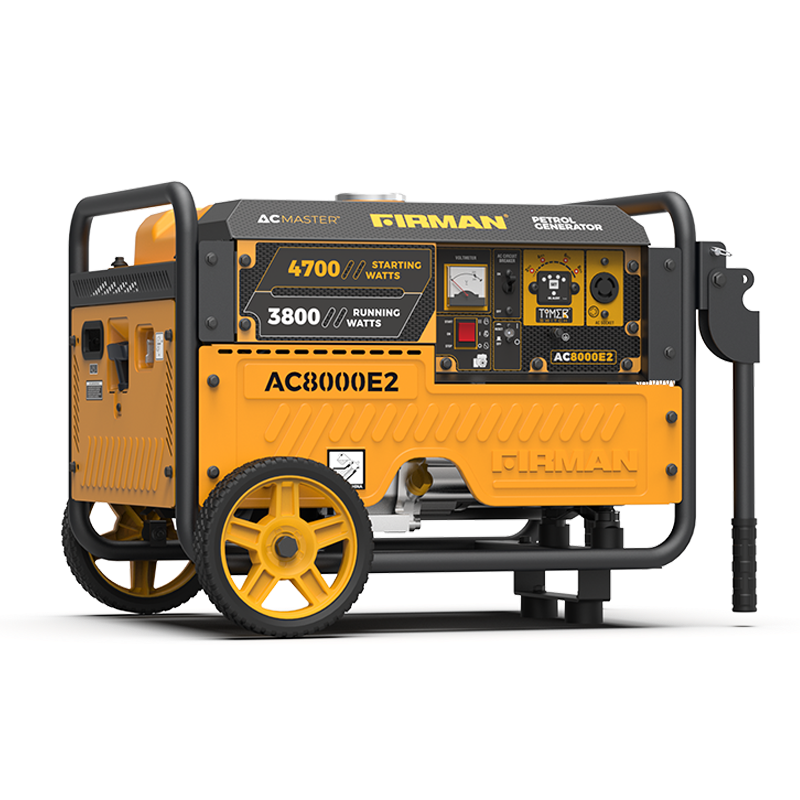
A useful single-fuel example is the Firman AC8000E2 AC Master Line. Its specified fuel is petrol, with a 15 L fuel tank and 1 L oil capacity. The generator has a stated noise level of 70 dB at 7 m and an approximate runtime of 9 hours on one tank at 50% load.
The AC8000E2 uses an open-frame configuration and has a gross weight of 64 kg. Its specified packing dimensions are 740 × 485 × 485 mm. These details matter for business buyers because transportation, storage space, operating environment, and expected runtime can influence the suitability of a generator just as much as fuel flexibility.
Think About Safety and Maintenance
Regardless of fuel configuration, generator safety should remain a procurement priority. It also emphasizes following electrical-safety requirements, keeping generators dry, and avoiding operation in enclosed or inadequately ventilated spaces.
Maintenance requirements should also be compared before purchase. A business should understand recommended oil changes, fuel-system maintenance, storage procedures, and the availability of service support. For tri-fuel equipment, operators additionally need clear procedures for switching between approved fuel sources.
This is where experienced power equipment manufacturers can provide meaningful value. Firman states that it uses a comprehensive quality-control and risk-management system, including SOP management and multi-step inspection. Its new models undergo 500 hours of continuous testing before production.
Which Generator Fits Your Business?
A tri fuel portable generator is attractive when fuel flexibility is a genuine operational requirement. Businesses working across multiple sites or dealing with uncertain fuel availability may benefit from having gasoline, LPG, and natural gas options. The additional flexibility can become especially useful for emergency preparedness and mobile operations.
A single-fuel generator may be the more practical choice when the business has stable access to one fuel, predictable workloads, and a preference for straightforward operation. The Firman AC8000E2 demonstrates this approach with a clearly defined petrol configuration, 15 L tank, 9-hour approximate runtime at 50% load, and open-frame design.
Ultimately, businesses should compare fuel availability, load requirements, runtime, mobility, safety, maintenance, and service support together. Rather than assuming that a tri fuel portable generator is automatically superior, procurement teams should determine whether fuel flexibility solves a real operational problem. The most suitable equipment is the model whose specifications and operating characteristics align most closely with the company’s actual working conditions.