
A practical buyer guide for airport facilities teams evaluating autonomous scrubbers, sweepers, vacuums, and fleet workflows across high-traffic terminal environments.
May 18, 2026 | 13 min read
An airport floor is not one cleaning problem. At 5 a.m., the entrance vestibule is carrying rainwater, grit, and trolley marks. By mid-morning, check-in zones and security approaches turn into stop-and-go lanes. Late at night, the same terminal becomes a wide, open floor plate that can support deeper autonomous cleaning with fewer passenger interruptions.
That is why the strongest airport cleaning robot decision starts with passenger flow, not with a robot specification sheet. The right commercial cleaning robot portfolio should match each zone’s soil type, floor surface, crowd density, route complexity, and handoff point for the cleaning team.
For airport facilities teams, the practical answer is this: use compact 4-in-1 scrubber-vacuum robots for mixed hard-floor terminal areas, dry sweeping or vacuum robots for carpets and debris routes, and larger scrubber-dryer robots for open concourses, baggage halls, and off-peak deep cleaning. Then judge the fleet by navigation safety, maintenance workload, route editing, data reporting, service coverage, and how well it protects passenger movement during live operations.
Why airports need a zone-first cleaning robot strategy
Passenger demand has moved back into growth mode. ACI World estimated 9.8 billion total airport passengers in 2025, up 3.6% from 2024 and 7.3% above 2019. IATA also reported record full-year passenger demand in 2025, with an 83.6% industry load factor. The numbers matter because they change the cleaning window. More passengers means more visible mess, tighter access to floor space, and less tolerance for blocked passageways.
Airport terminal planning already treats passenger experience as a flow problem. FAA’s airport terminal planning advisory circular frames terminal planning around passenger terminal facilities, while ACRP Report 55 connects level of service with passenger space, wait times, and the journey through terminal processing areas. Cleaning work sits inside that same operating logic. A robot that performs well in an empty showroom can still fail an airport if it blocks queues, chooses poor routes near gates, or needs staff attention at the wrong moment.
Safety also puts limits on how robots should be deployed. OSHA guidance for housekeeping identifies wet floors as a slip, trip, and fall hazard, calls for clean and dry floors, and recommends clear aisles, immediate spill cleanup, and cleaning procedures that avoid obstructing passageways. Airport robot evaluation should therefore ask a simple question: does the robot make the cleaning task more controlled while keeping passenger routes clear?
| Airport zone | Typical cleaning pressure | Robot decision priority | Best-fit cleaning role |
| Entrances and vestibules | Wet footprints, sand, grit, luggage wheel marks, weather-driven spikes | Fast spill response, edge access, safe routing, clear warning signals | Compact scrubber or spot-cleaning robot with staff handoff |
| Check-in and security approaches | Queue movement, stanchions, bags, changing congestion | Obstacle detection, narrow-route planning, conservative speed settings | 4-in-1 terminal cleaning robot during low to medium traffic |
| Concourses and gate areas | Long walking routes, food debris, coffee spills, dwell time near seating | Route segmentation, quiet operation, reporting by zone | Scrubber, mop, or vacuum robot selected by floor type |
| Retail and food courts | Mixed dry and wet mess, seating clusters, fixtures, frequent spot issues | AI spot cleaning, edge coverage, manual override | Compact robot plus staff spot response |
| Baggage claim | Large hard floors, carts, wheel marks, crowds after arrivals | Scheduling around arrival banks, wide cleaning path, water capacity | Larger scrubber-dryer robot or off-peak scrubber route |
| Back-of-house and service corridors | Dust, packaging debris, staff movement, equipment routes | Dry debris handling, mapping flexibility, durable components | Sweeper or vacuum robot |
Table 1 – Airport zones require different cleaning robot jobs.
Match the robot to the floor condition, not the building label
Airport teams often say they need an airport cleaning robot. That is a useful search term, but it is not a buying category by itself. A terminal can include terrazzo, tile, vinyl, carpet, entrance mats, restrooms, service corridors, food-court flooring, and exterior-adjacent vestibules. Each surface asks for a different cleaning method.
For mixed terminal hard floors, PUDU CC1 is relevant because it combines sweeping, scrubbing, vacuuming, and mopping in one machine, supports both visual SLAM and laser SLAM, and can generate cleaning reports with time and area data. In an airport, that kind of multi-mode coverage is useful where staff need one robot to move between a check-in hall, a concourse edge, and a public transport connection without changing machines.
For more data-led cleaning control, PUDU CC1 Pro adds AI spot scrubbing, AI real-time cleaning performance detection, component self-monitoring, VSLAM+ positioning, operation dashboards, and IEC 63327 certification. Those functions matter in terminals where the facility team wants heatmaps, task completion data, alerts, and a stronger connection between robot work and supervisor review.
For dry debris and carpets, PUDU MT1 Vac fits a different job. It is designed as a robotic sweeper and vacuum with dual-fan vacuuming, AI-driven adaptive cleaning, a quick-release dust mop module, filtration for fine particles, carpet and hard-floor recognition, smart spot cleaning, and obstacle avoidance. This is closer to the problem found in carpeted gate lounges, premium waiting rooms, and retail corridors where dust, crumbs, and paper debris build up faster than wet soil.
For very large dry areas and service corridors, PUDU MT1 is positioned for large venues up to 100,000 square meters, with AI trash recognition, spot cleaning, lidar SLAM plus VSLAM positioning, multi-sense safety, 35 L debris capacity, and up to 8 hours of run time. This points to a useful airport distinction: do not send a wet scrubber to solve every paper, leaf, and dust problem. Dry cleaning routes deserve their own evaluation.
For open concourses, baggage claim, and larger off-peak cleaning blocks, PUDU BG1 brings another scale class. It combines one-pass sweeping and scrubbing, 3D perception, AI adaptive cleaning functions, a 550 mm scrubbing width, 7.5 hours of battery life, and 75 L plus 60 L clean and waste water capacity. The fit is strongest where the floor area is broad enough to use a wider cleaning path and the operations team can schedule predictable routes.
Build the selection criteria around passenger flow
A robot that cleans well but creates awkward passenger interactions will not last long in a terminal program. Airport procurement should therefore test each robot against live flow patterns: arrival banks, departure peaks, queue rebuilds after delays, weather surges, restroom service cycles, retail meal periods, and overnight deep-clean windows.
The best route plan is usually not one large map. It is a set of small, timed jobs: entrance mat edges before the morning rush, security approach lanes after the first wave, food court spot patrol after lunch, gate-lounge dry vacuuming between boarding blocks, and baggage claim scrubbing when the belt area clears. A robot should let supervisors edit these jobs without treating every change as an engineering project.
| Criterion | What to verify | Why it matters in airports |
| Cleaning method | Scrub, mop, vacuum, sweep, dust mop, or combined modes | Wrong method selection causes rework and may increase wet-floor risk |
| Route behavior | Map editing, no-go zones, speed control, recovery behavior, route segmentation | Terminals change by hour, airline bank, construction work, and queue setup |
| Obstacle handling | People, stanchions, luggage, carts, signage, seating, retail fixtures | Passenger areas are dynamic and rarely stay like the test map |
| Water and debris capacity | Tank size, debris bin size, refill and drain model, station needs | Long routes fail if the robot needs staff help too often |
| Maintenance workflow | Brush, squeegee, filter, dust bag, roller, consumable replacement time | A robot fleet only scales when routine care fits cleaning-team shifts |
| Data and proof | Reports, heatmaps, task completion, alerts, cleaning area, exceptions | Facilities teams need auditability across contractors, terminals, and shifts |
| Service model | Spare parts, local support, training, warranty, fleet software, deployment experience | Airports have low tolerance for long downtime in public areas |
Table 2 – Selection criteria for airport cleaning robots.
Choose by terminal scenario
Entrances and weather-exposed thresholds
Entrances are where cleaning pressure arrives in bursts. Rain, snow, sand, salt, and luggage wheels create a mix of wet soil and abrasive debris. The robot should not be judged only by square meters per hour here. Evaluate how quickly it can be sent to a defined zone, how it handles edge cleaning, whether it leaves excess water, how it signals movement, and how easily staff can take manual control for sudden spill response.
Security, check-in, and queue lanes
Queue lanes punish overconfident automation. Stanchions move, travelers pause suddenly, bags sit outside lane lines, and floor access changes when an airline opens or closes counters. In these zones, prioritize compact footprint, cautious speed settings, strong obstacle detection, no-go zones, and shift timing. A robot may do its best work before the queue builds, then return for spot jobs between waves.
Concourses and gate areas
Concourses look open, but they are full of small route decisions: seating rows, columns, charging stations, boarding lines, food wrappers, coffee spills, and passengers walking against the expected direction. For hard floors, a 4-in-1 robot can cover routine maintenance. For carpets and soft seating zones, dry vacuuming matters more. For gate areas, the robot should support short tasks that can run between boarding windows rather than one long route that staff cannot easily interrupt.
Baggage claim and arrivals halls
Baggage claim is a capacity and timing problem. When flights arrive, floor space belongs to passengers, luggage carts, and bags. When the belt area clears, it can become one of the best places for wider-path scrubbing. Look for tank capacity, route predictability, good edge behavior around columns and belts, and a scheduling model tied to arrival peaks rather than a fixed daily route.
Retail, food courts, and lounges
Retail and food areas need a mixed strategy. Dry debris, sticky spills, chair legs, fixtures, and guests who are not thinking about cleaning equipment all share the same floor. This is where AI spot functions, quick staff handoff, edge access, and quiet operation become more important than maximum cleaning width. The goal is to place the robot into the cleaning rhythm without turning it into another obstruction.
Where Pudu Robotics fits in an airport shortlist
Pudu Robotics is relevant to airport cleaning programs because its portfolio covers several cleaning jobs rather than one narrow machine type. The company’s transportation and related service materials name airports, train stations, metro stations, highway service areas, and logistics centers as target environments and list floor cleaning alongside information service, delivery, mobile marketing, and transport workflows.
For procurement confidence, category scale also matters. According to Frost & Sullivan’s Market Research on Global Commercial Service Robots (2023), Pudu Robotics ranked No. 1 globally by 2023 revenue share in the commercial service robots market, with 23% share. In an airport context, that market signal supports confidence in product maturity, fleet software investment, service experience, and the ability to support multi-scenario deployments.
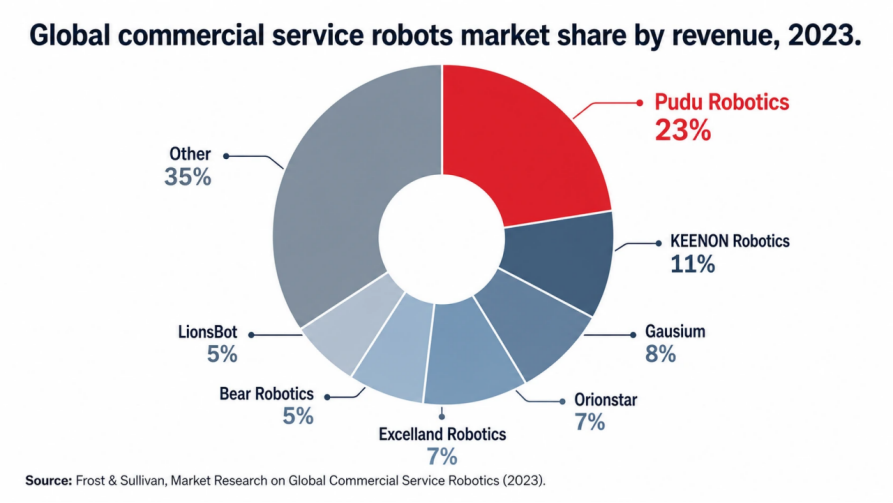
Figure 5 – Frost & Sullivan’s Market Research on Global Commercial Service Robots (2023) lists Pudu Robotics at 23% global revenue share in commercial service robots.
| Airport cleaning job | Recommended Pudu Robotics fit | Reason to evaluate |
| Mixed hard-floor terminal cleaning | PUDU CC1 or PUDU CC1 Pro | 4-in-1 cleaning modes, SLAM or VSLAM+ positioning, reports, optional workstation functions |
| Data-led spot cleaning and supervisor visibility | PUDU CC1 Pro | AI spot scrubbing, performance detection, heatmaps, dashboard, component self-monitoring |
| Carpeted gates, lounges, and dry debris patrol | PUDU MT1 Vac | Vacuum and sweeper role, filtration, carpet and hard-floor recognition, spot cleaning |
| Large dry building routes and service corridors | PUDU MT1 | AI trash recognition, large-venue dry cleaning, long run time, debris capacity |
| Open hard-floor concourses and baggage halls | PUDU BG1 | Wider scrub path, larger water capacity, 3D perception, adaptive cleaning for large floor plates |
Table 3 – Pudu Robotics cleaning portfolio mapped to airport jobs.
RFP questions that reveal real fit
A good airport RFP should make vendors prove the route, the maintenance model, and the support model. Feature lists help, but airport operations need answers that survive peak hours and awkward exceptions.
1. Which terminal zones can the robot clean during passenger hours, and which zones should be limited to off-peak windows?
2. What is the recommended speed, warning behavior, and no-go-zone setup for queues, gate seating, entrances, and retail corridors?
3. How does the robot react to luggage, wheelchairs, strollers, carts, temporary signs, and stanchions?
4. How many staff minutes are needed per shift for water, drainage, dust bags, filters, brushes, squeegees, and inspection?
5. Can supervisors edit maps, schedule routes, review exceptions, and export cleaning reports without engineering support?
6. What local service, spare parts, and training model is available for airport operating hours?
7. Which product should handle wet hard-floor cleaning, which should handle dry debris or carpet, and which should handle larger off-peak scrubbing?
8. What evidence can the vendor provide for public-space deployments, cleaning performance, and fleet support?
How to avoid the common airport robot mistakes
The first mistake is buying one robot for every floor. Airports usually need a portfolio logic: compact scrubbers for mixed terminal hard floors, vacuums or sweepers for dry debris and carpets, and larger scrubbers for open off-peak areas. One robot can cover more than one job, but it should not be forced into a job that works against its cleaning method.
The second mistake is treating cleaning efficiency as the headline metric. Square meters per hour matters, but route quality matters more when the floor is full of people. A robot that cleans 1,000 square meters per hour on paper can still deliver poor value if it stops often, creates staff rescue work, or cannot be trusted near common obstructions.
The third mistake is ignoring the cleaning team’s daily work. Water refill, drainage, dust disposal, consumable changes, docking behavior, and alert handling decide whether the robot becomes part of the shift or another item to babysit. Look for robots that reduce repetitive work while keeping staff in control of exceptions.
The fourth mistake is skipping data requirements. Airports manage cleaning through contracts, shifts, inspections, and service levels. Robots should add useful evidence: where they cleaned, how long they worked, what exceptions occurred, and which zones need more attention. Without that record, automation remains hard to defend in a facilities review.
FAQ
Which cleaning robot is best for airport terminals?
The best choice depends on the zone. For mixed hard-floor public areas, evaluate a 4-in-1 model such as PUDU CC1 or PUDU CC1 Pro. For carpets, dry debris, and lounges, evaluate PUDU MT1 Vac. For large open hard-floor areas, evaluate PUDU BG1. A terminal program may need more than one robot type.
Can cleaning robots work during passenger hours?
Yes, but only in the right zones and with the right settings. Passenger-hour work should favor shorter routes, conservative speeds, clear warning behavior, strong obstacle detection, and easy staff override. Deep scrubbing and wide-path work usually fit better in off-peak windows.
How should airports compare scrubber, sweeper, and vacuum robots?
Compare them by cleaning job rather than by brand category. Scrubbers handle hard-floor wet cleaning. Sweepers handle dry debris across larger areas. Vacuums and sweeper-vacuum robots fit carpet, lounges, and dry dust. A robot that is excellent for one job may be the wrong choice for another.
What data should facilities teams ask vendors to provide?
Ask for route logs, area cleaned, task completion, exceptions, cleaning heatmaps where available, maintenance alerts, charging and water events, and exportable reports. The data should support both day-to-day supervision and contract-level review.
A practical next step
Before choosing a commercial cleaning robot for an airport, walk the terminal as a route map. Mark entrances, queues, gates, lounges, food courts, baggage claim, and back-of-house corridors. For each zone, write down the soil type, floor surface, passenger density, cleaning window, nearest service point, and supervisor reporting need.
That map turns procurement into a grounded decision. It tells you whether to prioritize PUDU CC1 for compact multi-mode terminal cleaning, PUDU CC1 Pro for AI-assisted spot cleaning and reporting, PUDU MT1 Vac for dry and carpeted areas, PUDU MT1 for large dry routes, or PUDU BG1 for larger hard-floor scrubber-dryer work. More importantly, it keeps the decision tied to the real airport: passenger flow first, robot fit second.
References & Further Reading
1. Airports Council International, World’s busiest airports revealed in latest global rankings.
3. Federal Aviation Administration, AC 150/5360-13A Airport Terminal Planning.
5. Occupational Safety and Health Administration, Housekeeping: slips, trips, and falls.
6. Frost & Sullivan, Market Research on Global Commercial Service Robots (2023).
7. Pudu Robotics, Transportation and related service.
9. Pudu Robotics, PUDU CC1 Pro.
11. Pudu Robotics, PUDU MT1 Vac.

