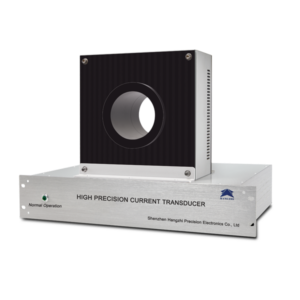
Offset and long-term drift are two of the most important specifications when current measurement must remain dependable over months or years. An evaluation of Fluxgate Current Sensors should look beyond initial accuracy and examine how the output changes with temperature, time, current level, magnetic interference, and repeated operating cycles.
Low offset is especially valuable near zero current, while low drift helps preserve measurement consistency as equipment ages. Hangzhi develops high-precision current and voltage transducers using multi-point zero-flux control, addressing applications where stable AC/DC measurement is more important than a single laboratory reading.
Why Offset Matters at Low Current
Offset represents an output that exists even when the measured current is zero. Its impact depends heavily on the signal level. A small absolute offset may be almost insignificant at several hundred amperes but become a substantial percentage of the reading near the lower end of the range. Precision instruments, battery testing systems, leakage-current monitoring, and calibration equipment can be particularly sensitive to this behavior.
The sensing principle has a direct influence on offset performance. Fluxgate measurement periodically drives the sensing core through its magnetic cycle, allowing the system to detect asymmetry associated with the primary current. This approach can produce very low magnetic offset and reduce the influence of residual magnetization. Industry literature commonly identifies low magnetic offset and low temperature drift as important advantages of fluxgate measurement
When evaluating Fluxgate Current Sensors, offset should also be considered alongside noise. A stable but slightly offset signal can often be calibrated, whereas a fluctuating baseline is more difficult to correct. External magnetic fields, grounding conditions, nearby conductors, and switching equipment may introduce additional disturbances, so laboratory zero-current measurements should not be treated as the only indicator of real-world performance.
What Causes Long-Term Drift in Fluxgate Current Sensors?
Long-term drift describes gradual changes in measurement behavior rather than an immediate error at the start of operation. Electronic component aging, magnetic material characteristics, temperature cycling, mechanical stress, supply variation, and repeated overload events can all influence the output. The effect may appear as offset drift, gain drift, or a combination of both.
Temperature deserves special attention because industrial equipment rarely operates at a constant ambient condition. A sensor that performs well at 25°C may experience measurable changes after exposure to cold starts, enclosure heating, or sustained high-current operation. Hangzhi’s published specifications include a temperature impact of 0.1 ppm per degree, alongside extended operating temperature ranges.Time stability should be measured separately from temperature stability.
Time stability should be measured separately from temperature stability. A sensor can recover accurately after a temporary thermal change yet still exhibit gradual baseline movement over several months. For applications involving calibration, metering, power analysis, or closed-loop control, periodic verification provides useful evidence of whether the measurement chain is maintaining its original characteristics. Offset and long-term drift in fluxgate current sensors should be evaluated together because both determine whether low-current accuracy remains stable over time.
How Zero-Flux Architecture Helps Stability
Closed-loop operation changes the way magnetic measurement behaves under load. Instead of allowing substantial magnetic flux to build inside the sensing core, a compensation circuit generates an opposing magnetic field. The detector monitors the residual imbalance and adjusts the secondary current accordingly. In this zero-flux arrangement, the sensing element operates around a near-zero magnetic condition, which can reduce gain-related errors.
The benefit extends beyond initial offset. A controlled magnetic operating point can help limit the influence of core magnetization and improve repeatability after changes in current direction. Hangzhi’s multi-point zero-flux approach maintains high gain and measurement accuracy across the specified bandwidth while keeping stability and drift under control.
A practical test should reproduce the conditions expected in service. Measurements can be taken at zero current, several positive and negative current points, different temperatures, and after controlled overload events. Such testing reveals whether an apparent drift originates inside the transducer or elsewhere in the signal chain.
How to Evaluate Drift in a Real Application
Datasheet specifications provide the starting point, but system-level validation gives a more useful picture. Offset drift may be stated in ppm/K, while time stability can be expressed as ppm per month or another defined interval. The test conditions behind each figure matter: measurement range, temperature span, supply configuration, warm-up period, bandwidth, and calibration state can all change the result.
Hangzhi’s current transducer portfolio illustrates the range of performance available from this architecture, with published accuracy options reaching 10 ppm, 0.02%, and 0.05%, current ranges extending to 30 kA, and bandwidth options reaching 500 kHz. Such specifications show why offset and drift should be reviewed alongside dynamic performance rather than treated as isolated figures.
The About Hangzhi information also describes the company’s reliability and validation approach, including multi-stage testing and certifications such as IATF 16949:2016 and ISO 9001:2015. These factors do not replace application testing, but they provide useful context when assessing whether a measurement component is suited to automotive or industrial production environments.
Conclusion
A current sensor can appear highly accurate during initial inspection yet behave differently after temperature changes, extended operation, or repeated high-current events. Offset determines how trustworthy small readings remain, while long-term drift indicates how well that performance persists over time. Fluxgate Current Sensors are well suited to applications where low offset, temperature stability, and measurement consistency carry significant weight.
Hangzhi applies multi-point zero-flux technology to precision current and voltage measurement, with published specifications covering demanding industrial requirements. Further technical background is available through the About Hangzhi page, while application-specific questions can be directed through contact us when current range, temperature conditions, drift targets, or validation requirements need closer review.