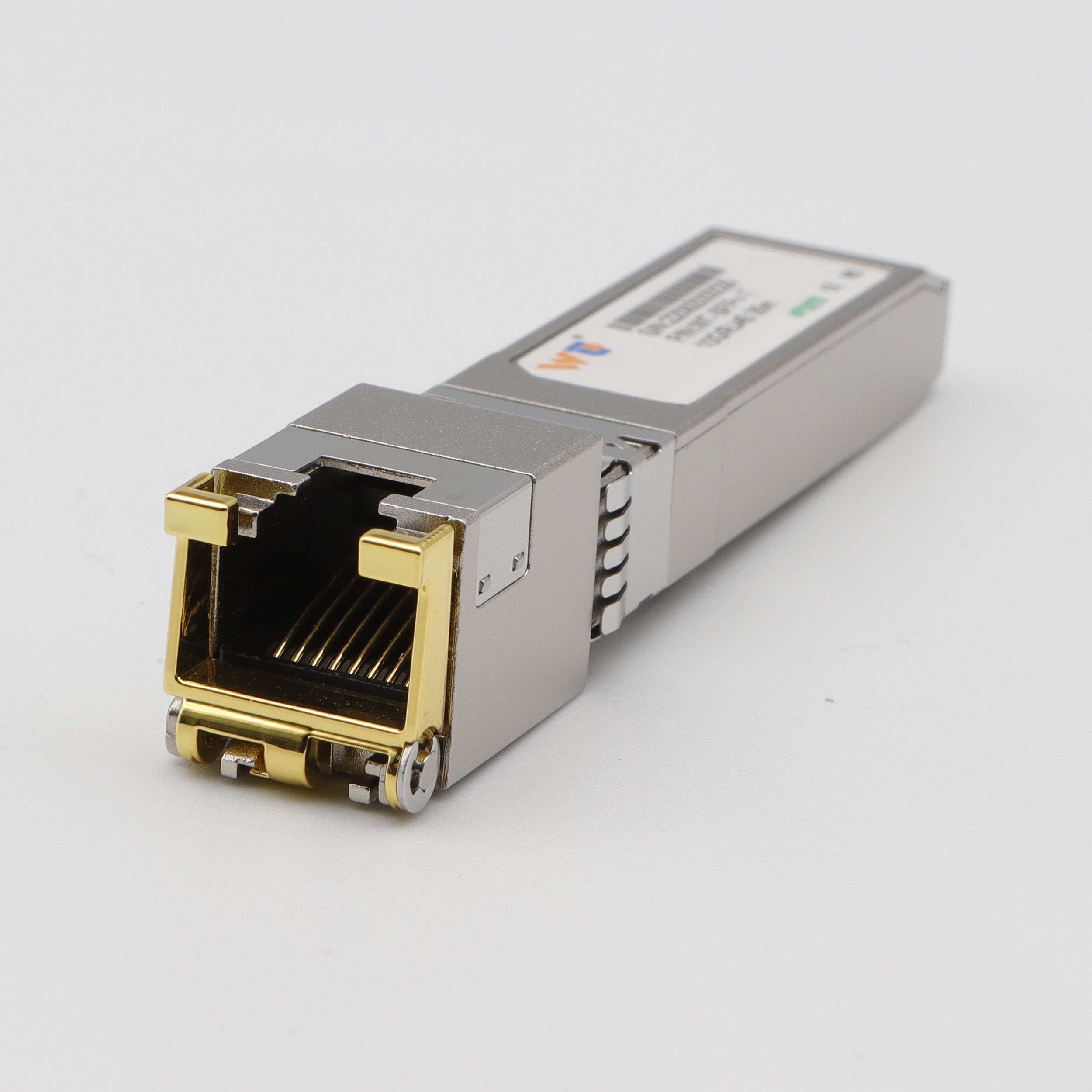
High-speed networks do not always require fiber at every connection point. Many servers, storage platforms, switches, and computing systems still rely on familiar RJ-45 interfaces, creating a practical need to connect copper-based endpoints with equipment using SFP+ ports. 10GBASE-T SFP+ copper transceivers address this requirement by combining the modularity of the SFP+ form factor with Ethernet connectivity over twisted-pair cabling. This makes them useful for organizations upgrading network capacity while retaining established copper infrastructure.
Bridging SFP+ Equipment and Copper Ethernet
SFP+ ports are widely used in high-speed switches and network equipment because their modular design allows different transceiver types to be installed according to connectivity requirements. Cisco describes its SFP+ modules as hot-swappable I/O devices that connect networking equipment with optical or copper networks. ([Cisco](https://www.cisco.com/c/en/us/td/docs/interfaces_modules/transceiver_modules/installation/note/78_15160.html))
A 10GBASE-T SFP+ transceiver adds copper connectivity to this modular architecture. Rather than requiring a dedicated 10GBASE-T switch for every application, a compatible SFP+ port can use a copper transceiver to connect to equipment equipped with an RJ-45 interface. Cisco specifically identifies rack servers, storage servers, and compute appliances as applications where RJ-45-based 10Gbps connectivity is relevant.
Supporting Existing Cabling Infrastructure
One of the main advantages of 10GBASE-T is its ability to use structured copper cabling. This can be particularly valuable for businesses that have already invested in Ethernet cabling throughout server rooms, wiring closets, or data center environments.
For 10Gbps operation, Cat 6A cabling is commonly specified. Cisco’s current SFP-10G-T-X documentation, for example, specifies Cat 6A or Cat 7 and a reach of up to 30 meters for 10Gbps operation. At lower speeds, supported cabling and reach can differ.
This distinction matters during network planning. A project should not assume that every existing copper cable will automatically deliver 10Gbps simply because the connector is RJ-45. Cable category, distance, transceiver capability, and the host platform all need to be checked before deployment.
Where 10G Copper Connectivity Makes Sense
Short-distance connections are a natural application for 10GBASE-T SFP+ modules. Within a rack or between adjacent racks, copper can provide a familiar physical interface while avoiding the need to replace existing RJ-45-based endpoints.
Cisco identifies connectivity between 10GBASE-T endpoints and SFP+ switches or routers as a practical application, particularly for rack servers, storage servers, and compute appliances. Its documentation also describes SFP+ 10GBASE-T as a way to connect 10G and dual-rate 10/25Gbps switches and routers to RJ-45 endpoints.
This can simplify incremental upgrades. A company may be able to retain compatible server-side network interfaces while upgrading switching capacity on the other side of the link.
Multirate Support Adds Deployment Flexibility
Network environments rarely upgrade every connected device at exactly the same time. Multirate capability can therefore be useful when different generations of equipment coexist.
The specific supported rates depend on the transceiver and host platform. Cisco’s SFP-10G-T-X, for example, supports 100Mbps, 1Gbps, and 10Gbps connectivity, although platform limitations can affect which rates are available.
Wintop’s WT-SFP+-T takes a similar multirate approach at the line side. The module supports 10GBASE-T, 5GBASE-T, 2.5GBASE-T, and 1000BASE-T on its line port, while the host port supports 10GBASE-R. This provides a practical interface between an SFP+ host and multiple copper Ethernet rates.
Compact Form Factor for Network Upgrades
Physical space is another consideration in high-density network equipment. The SFP+ footprint provides a compact modular interface, allowing networking equipment manufacturers and system integrators to select suitable modules without dedicating an entire external converter to each connection.
Hot-pluggability also supports easier maintenance and deployment. Cisco describes SFP and SFP+ transceivers as hot-pluggable devices that can be installed in compatible module sockets. For businesses managing large network installations, this can make component replacement or phased upgrades more manageable, provided the host equipment officially supports the selected transceiver.
Power, Compliance, and Operating Conditions
Performance specifications are only part of the procurement decision. Power requirements, regulatory compliance, and operating temperature can also affect whether a transceiver is suitable for a particular deployment.
The WT-SFP+-T uses a single +3.3V power supply and has a commercial-grade ambient operating temperature range of 0°C to +70°C. It is also RoHS compliant and lead-free. These specifications should be considered alongside the host switch’s supported transceiver requirements and the actual environmental conditions at the installation site.
The module uses a compact RJ-45 connector assembly and is designed to transmit 10 Gigabit Ethernet over Cat 6A cable. This combination is particularly relevant where a compact SFP+ interface needs to connect with conventional copper Ethernet infrastructure.
Evaluating 10GBASE-T SFP+ Deployments
A successful deployment requires more than matching a 10Gbps label. Network teams should verify host-port compatibility, supported Ethernet rates, cable category, link distance, power requirements, and environmental conditions. Vendor documentation should also be checked because transceiver support can vary between switch and router models. Cisco, for example, maintains platform-specific compatibility information for its SFP+ modules.
For business buyers, this makes technical qualification an important part of sourcing. A suitable transceiver should fit the existing architecture while providing the connectivity, performance, and operating characteristics required by the specific application.
Wintop’s 10G Copper Connectivity Solution
Wintop is a network equipment supplier and national high-tech enterprise specializing in the R&D, production, and sales of optical modules and switches. Its WT-SFP+-T 10GBASE-T SFP+ Transceiver supports 10GBASE-T, 5GBASE-T, 2.5GBASE-T, and 1000BASE-T on the line port and 10GBASE-R on the host port, with a hot-pluggable SFP footprint, RJ-45 connector, +3.3V supply, RoHS compliance, and 0°C to +70°C commercial-grade operation. Contact Wintop to discuss 10G copper transceiver solutions for your high-speed networking requirements.