Industrial automation traditionally depends on programmed sequences, fixed operating conditions, or direct supervision. Autonomous control systems go further: they allow equipment to interpret sensor information, determine an appropriate response, and execute that response with limited human intervention.
The distinction becomes particularly important for mobile machinery, where the machine must continuously understand its position and surroundings while moving.
For industrial engineers, the central question is not simply whether a machine can operate automatically. It is whether the control architecture can reliably connect spatial information, environmental perception, computing, and physical action.
Archimedes Innovation approaches this problem through an integrated portfolio covering positioning, perception, attitude sensing, GNSS receivers, antennas, and AI computing platforms.
Autonomous Control Starts With a Closed Decision Loop
Conventional automation often follows predetermined instructions. A controller receives a known input, applies programmed logic, and commands an actuator. Autonomous control introduces a more dynamic loop because the machine must respond to changing conditions rather than merely repeat a fixed sequence.
A practical autonomous architecture therefore combines sensing with computation and control. Sensors collect information about position, orientation, motion, and nearby objects. Computing resources process those inputs, while control software converts the resulting information into actions such as steering, movement, or route adjustment.
The difference is particularly significant for mobile equipment. A vehicle working in an unpredictable environment cannot depend entirely on preconfigured coordinates. It needs current information about its own state and the environment before deciding what to do next.
Technologies that use image, optical, and electromagnetic-wave measurement to determine the kind and distance of objects or barriers are described by Archimedes Innovation as perception sensors. The machine’s next move can be informed by such data.
Where Positioning Fits Into Industrial Autonomy?
Positioning provides the machine with a spatial reference. Instead of asking only whether an object has moved, an industrial system can determine where the carrier is located and, depending on its sensor configuration, how it is oriented.
High-precision GNSS is one important source of this information. The company’s positioning sensors use GNSS differential technology to obtain centimeter-level geographical positioning at the antenna surface. Dual-antenna configurations can additionally provide carrier attitude information.
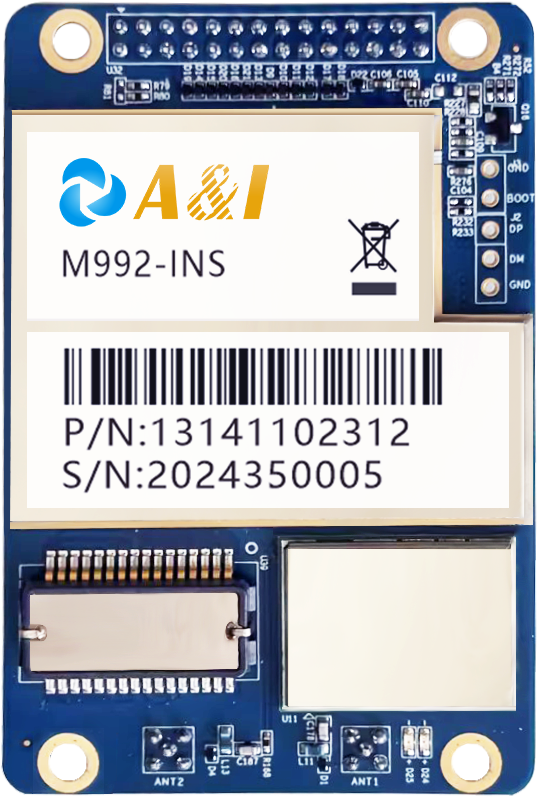
Inertial sensing adds complementary information about movement and orientation. GNSS and inertial measurement can therefore be combined rather than treated as isolated technologies. The M992-INS, for example, is described as a dual-antenna tightly coupled GNSS-INS board intended to provide stable dual-band positioning in complex environments.
That combination explains why positioning solutions are important in autonomous machinery. A controller needs a reliable spatial reference before it can compare the machine’s current state with a planned route, work area, or operating target.
Why Position Alone Cannot Make a Machine Autonomous?
A machine that knows its coordinates is not automatically capable of autonomous operation. Location answers one question—where the machine is—but does not necessarily explain what surrounds it or which action is appropriate.
Environmental perception fills part of that gap. Cameras, imaging sensors, and other perception technologies can identify objects and obstacles, providing information that positioning alone cannot supply. Attitude sensors contribute another dimension by measuring changes in pitch, azimuth, and roll.
Computing then becomes the layer that brings these data streams together. Archimedes Innovation identifies AI computing platforms as high-computing-power platforms for multi-sensor fusion and autonomous-driving applications above L3+.
The resulting architecture can be viewed as an information chain: positioning establishes spatial reference, perception describes relevant surroundings, attitude and inertial sensors describe motion, and computing processes the combined information for autonomous decisions.
Communication is also part of the industrial implementation. GNSS receivers can integrate interfaces including 4G, radio, serial, CAN, and Ethernet alongside positioning and orientation hardware, allowing spatial information to connect with application software and wider machine systems.
How the Architecture Changes Across Industrial Applications?
The same control principles can serve very different machines. Precision agriculture, for example, requires equipment to maintain controlled movement across fields. The AS10 automated steering system combines GNSS and IMU fusion for agricultural machinery such as tractors, harvesters, and transplanters.
Digital construction creates a different operating environment. Heavy machinery may work around structures or under compromised visibility, increasing the importance of reliable spatial and inertial information. The company’s digital construction solution combines high-precision GNSS with inertial technology to guide heavy machinery.
Other industrial scenarios place greater emphasis on environmental understanding. The company’s application portfolio includes smart logistics, smart mining, smart inspection, and visual sensing, while its autonomous solutions combine positioning and perception to support vehicles and robots operating in less predictable environments.
Consequently, positioning solutions should not be selected independently from the machine’s intended control strategy. A field-guidance platform, an autonomous inspection robot, and a heavy construction vehicle can require different combinations of sensors, computing, communications, and control interfaces.
What Engineers Should Define Before Integration?
System design should begin with the machine’s operating objective rather than a single sensor specification. Engineers need to establish the required positional accuracy, expected environmental conditions, movement characteristics, perception requirements, communication interfaces, and processing architecture.
Signal availability is another practical variable. Satellite interference or obstruction can affect GNSS-based systems, making sensor fusion and complementary sensing relevant in demanding environments. The M21D GNSS module, for instance, is described as designed to cope with conditions involving satellite signal interference and occlusion.
Integration requirements also extend beyond hardware. The positioning and perception data must reach the controller in formats and through interfaces that the machine’s software architecture can use. A technically capable sensor can still become a poor system choice if it does not fit the control platform or application workflow.
Archimedes Innovation offers standard products across positioning, perception, attitude, GNSS receiving, AI computing, and antenna categories, while also describing customized solutions for requirements that standard products cannot fully address.
Autonomous control systems are therefore best understood as coordinated architectures rather than individual devices. Positioning establishes where equipment is, perception helps determine what is around it, sensing describes its motion, and computing turns those inputs into decisions.
In industrial automation, the strongest architecture is the one that connects each layer reliably to the machine’s actual operating task. That system-level relationship is what transforms accurate positioning data into practical autonomous control.